
Recovery Is Part of the Circuit
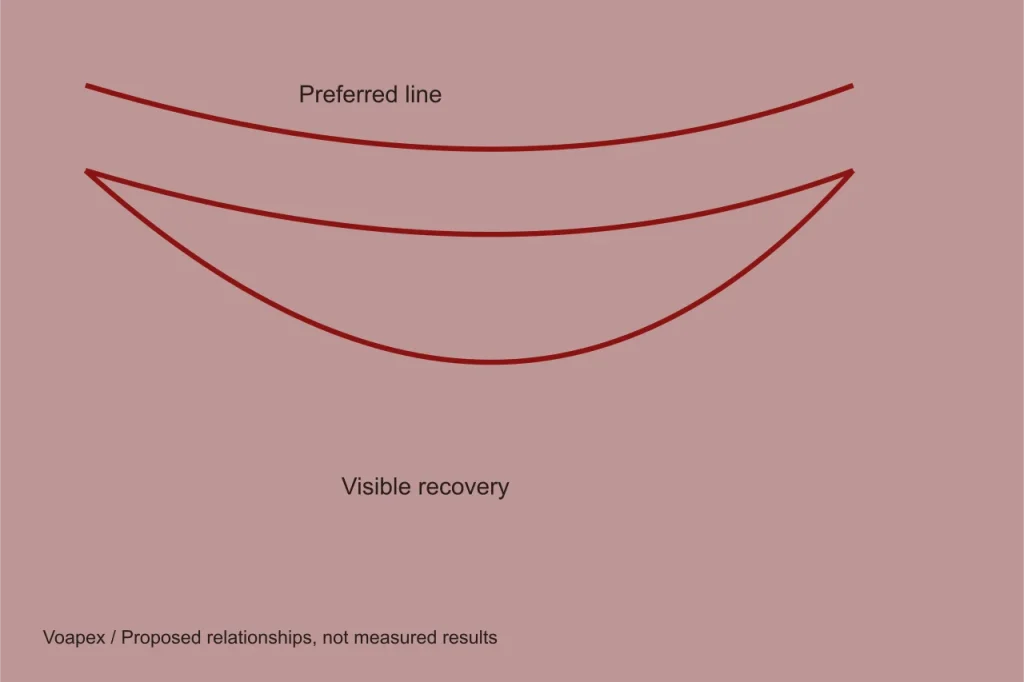
A missed apex does not have to end the useful part of a lap. A wider continuation can cost time while leaving the driver with a meaningful next decision. In Inversion Line, that recovery is especially important because an unusual track orientation can make a mistake difficult to interpret. The alternative route should be visible and consistent. It must not look like a safe apron in one corner and behave like an unexplained reset zone in the next.
01Mark a recovery area before it is needed
The driver should be able to recognise the broad continuation while approaching the preferred line. Surface treatment, edge shape and connection to the next section can establish its purpose. A last-second arrow is a poor substitute for coherent geometry. The recovery area should remain visually secondary without becoming ambiguous. If it resembles decorative architecture, a player may avoid it even when it is the sensible choice. If it looks like the main route, it may confuse the intended corner rather than support learning.
02Let the cost follow the route
A wider path can require more distance, a less favourable angle or a slower re-entry. Those consequences are understandable because they arise from the visible circuit. An arbitrary speed penalty may be appropriate in some designs, but it should not be used to conceal a recovery route whose geometry offers no real trade. The proposed approach begins with the shape of the continuation. The driver should be able to explain what was lost without consulting a hidden rule or a post-race list of unexplained deductions.
03Re-entry deserves its own space
Returning from a recovery area can create a new problem when other craft are present. The route should provide enough visibility and room for a deliberate rejoin. A reset that places a craft directly into traffic may punish both the recovering player and a rival who did nothing wrong. The current concept does not promise a particular multiplayer system. It identifies a spatial requirement that matters even with a single simulated opponent: recovery should restore participation without making the next moment arbitrary for everyone nearby.
04Preserve orientation through the mistake
An inverted corner can leave the driver unsure which surface is the useful continuation. Stable local references should remain available after the preferred line is missed. The orientation note discusses seams and structural rhythm before entry; those cues need to continue through the recovery path too. Removing them at the moment of error would make the circuit least readable when the driver needs help understanding it. Assistance should explain the same geometry, not create a contradictory route visible only in one mode.
05A recovery is not a free undo
Keeping control does not mean erasing the consequence of the mistake. The driver may lose position or compromise the next entry. The distinction is that they remain involved in responding to the situation. A complete reset can still be necessary when the craft leaves a supported area, but it should be clearly separated from ordinary wide running. The Circuit Studies use recovery as a comparison point between orientation and barrier proximity. Each concept needs costs related to its own central choice.
06Review what the route teaches
A first prototype could deliberately offer a common missed-apex situation and observe whether the wider continuation is understood. Completion alone would not prove success; the driver should be able to identify why that route cost time and where a better decision could begin. No such results are reported here. Voapex currently presents concepts and design notes, without a release date or public build. The aim is a circuit that continues to communicate after a mistake, so the next attempt is informed by a readable experience rather than a confusing interruption.