
An Inverted Corner Needs a Reference
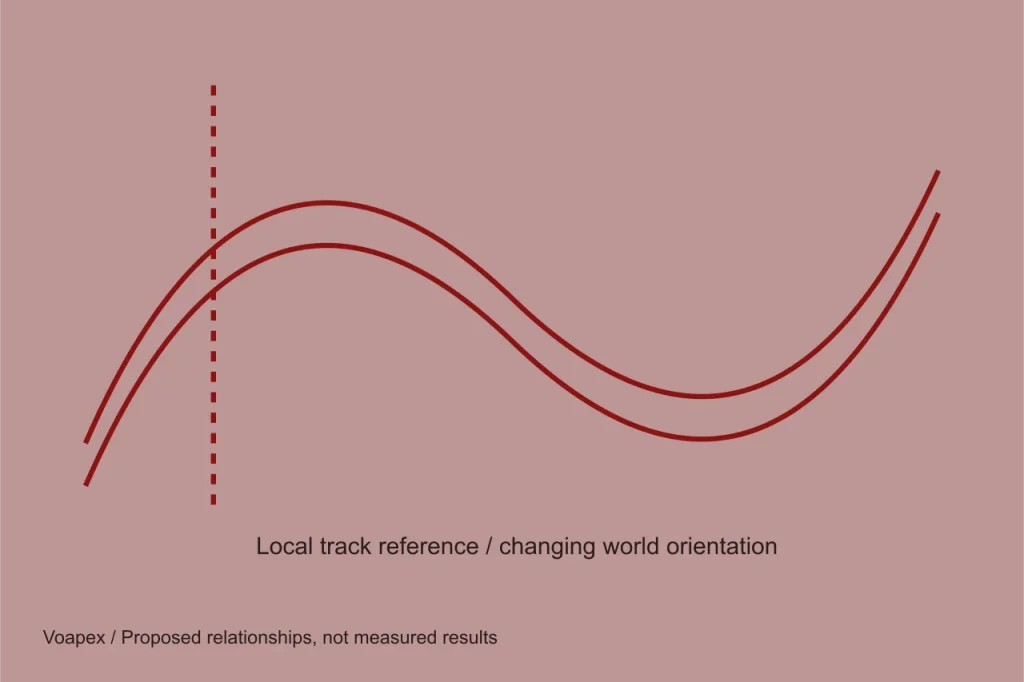
An inverted racing surface can be impressive before it becomes useful. If the driver loses every reference when the track rolls overhead, the challenge may become visual confusion rather than a meaningful corner. Inversion Line starts from a different goal: preserve enough information for a deliberate entry and a comprehensible exit while the world changes orientation. This note considers the references that could support that goal. It is a design proposal, not a report of a finished camera or handling system.
01Identify what must remain stable
The distant horizon is one possible reference, but it cannot carry the entire task on a surface designed to rotate away from it. A nearby seam or guide edge can provide a more local account of the route. The driver should understand which cue describes the track and which describes the wider world. Confusing those roles can make a visually smooth camera feel misleading. Before adding dramatic rolls, a prototype should establish how the craft’s position relates to a simple, clearly marked surface.
02Give the transition a visible approach
A change of orientation needs preparation. Repeated supports, a widening seam or the curvature of the outer edge can reveal the upcoming roll before the craft enters it. These cues should be large enough to read at speed and distinct from decorative detail. A warning icon might reinforce the information, but should not be the only source. If the shape can be understood only after the camera has already turned, the driver is reacting to a surprise rather than selecting a line.
03Keep camera comfort separate from route information
Some players prefer less roll or a more stable view. Those options should preserve the same corner geometry and nearby-rival information. A reduced-motion camera may need stronger local track references, but it should not conceal the intended route or provide an entirely different rule set. The design question is how to express one spatial relationship through several presentations. We cannot claim an implemented accessibility solution here; the concept identifies a requirement that would need practical testing with the actual driving interaction.
04Link the first corner to the second
The inverted section becomes tactically interesting when its exit prepares another turn. A driver can then choose a line for a reason beyond surviving the visual transition. Entering aggressively may leave a poor angle, while a wider approach may preserve steering room. The recovery note considers the related case of missing the preferred line. Both questions depend on showing the next useful space early enough for the driver to make an informed choice.
05Avoid using decoration as a false guide
A bright architectural strip can look like a route indicator even when it leads nowhere useful. The art direction should reserve the strongest repeated cues for relationships that matter to driving. Secondary structures can establish scale with less visual emphasis. In the proposed rose-and-burgundy setting, dark green guide elements help distinguish magnetic boundaries, while large structural silhouettes communicate the changing surface. The exact treatment remains open, but the hierarchy needs to be intentional rather than discovered accidentally after the scene is filled with detail.
06Test an explanation, not only a completion rate
A short prototype could ask a driver to explain which reference helped them predict the exit. Simply finishing the section would not prove that the route was readable; the player might have memorised a correction or followed an assist without understanding it. A useful review would distinguish those cases. No results are claimed here. The Handling Lab describes why Voapex begins with a small linked segment before proposing a longer circuit. The inversion should add a spatial question while leaving the driver enough evidence to answer it.