
TRACK DOSSIER / CONCEPT
Inversion Line
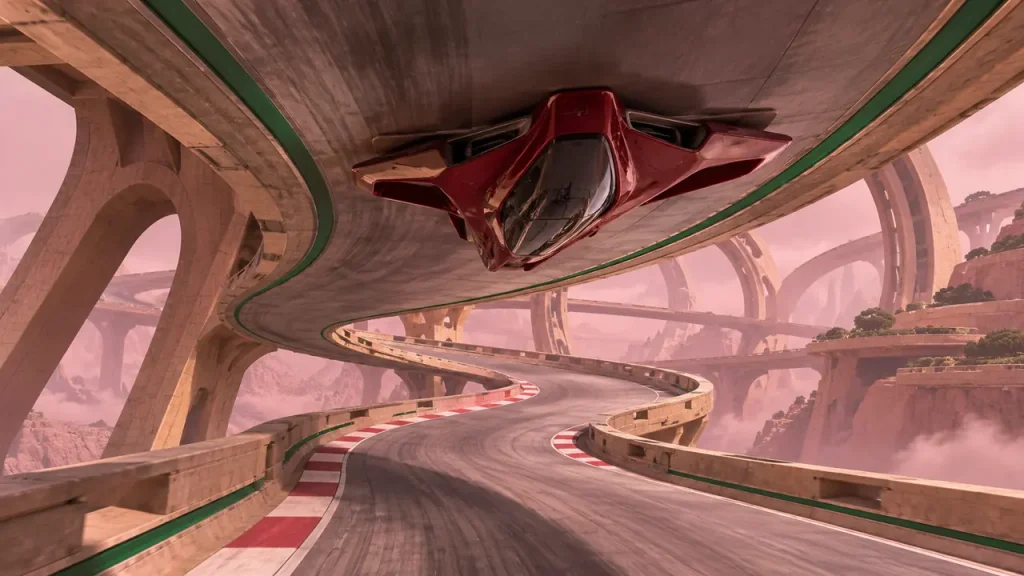
Inversion Line is a concept for anti-gravity racing through a compact sequence of banked and inverted corners. The driver skims a magnetic surface that can turn overhead, but the intended challenge is not simply to withstand visual disorientation. It is to read how the current corner prepares the next one and preserve a useful exit while the relationship to the horizon changes.
Read the transition before entering it
The proposed loop begins with a view of the upcoming surface. Structural seams, guide edges and a consistent sequence of supports establish the direction of the next turn. The driver chooses an entry position and speed that leave room for the transition. Those cues need to arrive early enough to support a choice. A sudden roll followed by a warning would test reaction to a surprise rather than understanding of the circuit.
Keep one reference while another changes
As the craft follows an inverted section, the distant world may rotate across the view. A nearby track reference can remain useful even when the horizon does not. The design needs to distinguish orientation cues from decorative lines. The inverted-corner note considers how a seam, a support rhythm and camera behaviour might work together. None should carry the entire burden alone, especially for players who prefer reduced camera motion.
The second corner gives meaning to the first
A chicane is interesting because an aggressive entry can leave a poor angle for the following change of direction. The proposed track uses that relationship rather than placing isolated dramatic turns in sequence. The driver may accept a wider first line to gain a cleaner second exit. The benefit should be visible in the craft’s position and available steering space, not only in a final lap-time number. A short segment can teach this relationship through repeated, understandable attempts.
A suspended testing district
The setting uses rose concrete spans, tan service platforms and dark green magnetic guide elements above a broad canyon. Large repeated structures establish scale, while gaps reveal the changing orientation of the route. The art direction avoids a dense field of flashing signs that competes with track information. Burgundy craft should remain distinct from the pale surface at both desktop and small-screen image sizes. The architecture supports the driving question instead of serving as unrelated spectacle.
A recoverable line is still a line
Missing the preferred apex should not automatically remove the player from the useful part of the circuit. A wider continuation can cost time while preserving control and a route into the next corner. The recovery study explores how to make that alternative visible before it is needed. The driver should know whether a broad apron is a legitimate recovery area or merely scenery that will trigger an abrupt reset.
Prototype scope and open questions
Inversion Line remains at concept stage, with no public build, release date or store page announced. A first prototype would focus on one linked pair of corners and a small set of camera options. It would ask whether players can identify a stable reference, explain a poor exit and choose a deliberate improvement. We do not claim testing results. The useful milestone is a short sequence that makes its handling relationship clear before the project expands into a longer circuit.