
TRACK DOSSIER / CONCEPT
Magnetic Wake
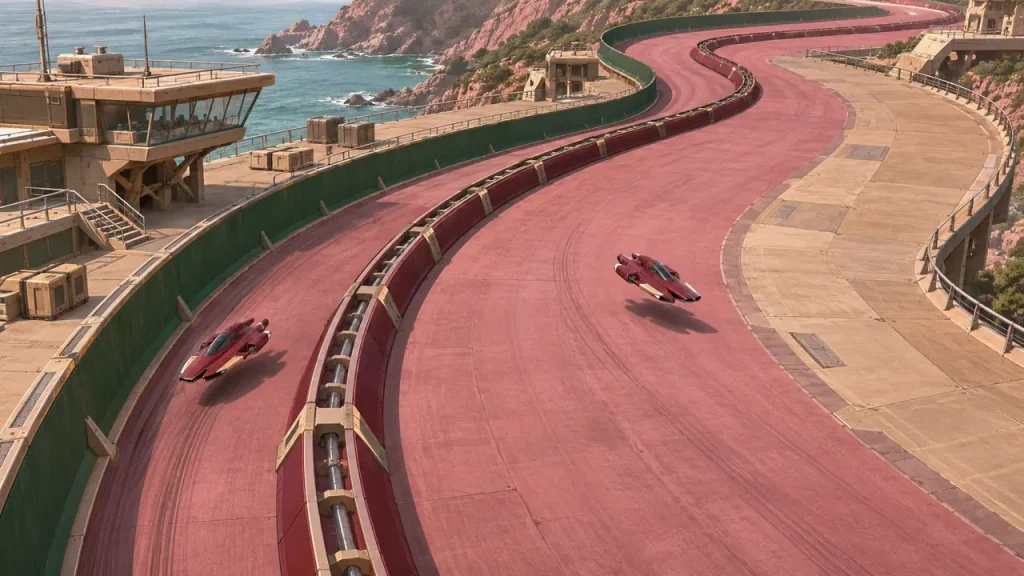
Magnetic Wake proposes an anti-gravity race in which the distance to a magnetic barrier changes the value of a line. A driver can skim close to the wall, but that proximity reduces the space available for a correction or a pass. The concept asks when a narrow opportunity is worth taking and when stepping away from the boundary creates a stronger next move.
Establish the barrier relationship
The opening segment should make the wall’s role clear without a rival occupying the same space. A guide strip, a stable craft response and a broad exit allow the driver to compare near and wide routes. The intended advantage must be defined through handling and position, not an unexplained bonus that appears whenever the craft touches a visual effect. The barrier-distance note examines how to make that trade readable before competitive pressure is added.
Follow, leave and rejoin
The proposed loop has three decisions. Choose a distance from the barrier, decide when the approaching corner or rival makes that distance less useful, and rejoin a broader route without losing the next entry. Leaving the wall should be an intentional part of driving, not simply a mistake that breaks a reward chain. A well-timed departure can create the space needed for an overtake or avoid a correction that would otherwise be too late.
Overtaking depends on the exit
A pass beside a wall can look complete while leaving the attacking craft with a poor angle for the next corner. Magnetic Wake therefore treats the exit as part of the opportunity. The driver should read both the rival’s current position and the space beyond it. The overtaking note follows that preparation. The concept should not encourage contact through an opaque collision system or imply that every narrow gap is a fair invitation to pass.
A coastal circuit with visible alternatives
The art direction places the track beside a rocky coast, using broad rose surfaces, tan service areas and dark green barrier elements. A high view reveals the near-wall route and the wider recovery apron as parts of one circuit. At driving height, repeated supports and clear edge geometry should preserve the same relationship. The environment is deliberately less visually dense than a neon city, so the driver can distinguish the boundary that affects handling from structures that only establish scale.
Costs that remain understandable
A risky line should have consequences connected to the risk taken. Running too close can reduce correction room; leaving late can compromise the next entry. We would avoid arbitrary speed loss that has no visible cause. Assistance options could clarify a route or soften a recovery without pretending the geometry has changed. The goal is to support different learning needs while keeping the central choice intact: how much space should be traded for the opportunity beside the wall?
What is proposed, not promised
Magnetic Wake is a concept study. No public version, launch date, competitive ranking system or commercial platform is announced here. A first trial would compare two routes through one bend, then add a single rival to examine whether the overtaking choice remains readable. We have no measured results to report. The wider Circuit Studies show how this proximity question differs from the orientation problem in Inversion Line.