
Close to the Wall Is Not Always Faster
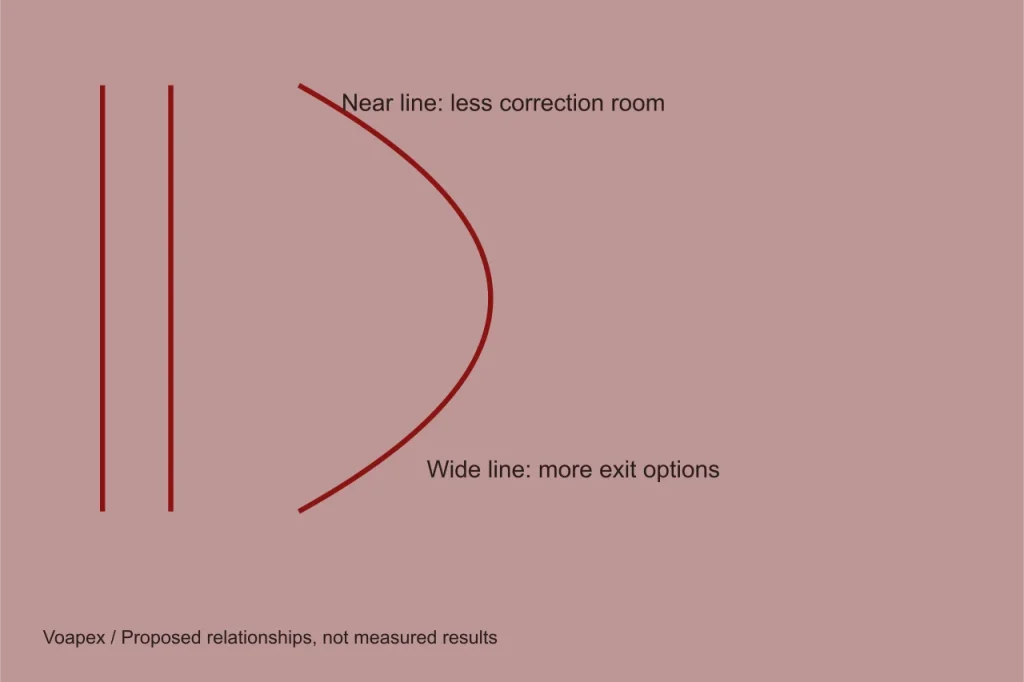
A glowing wall can easily become a simple instruction: stay close to receive a reward. That would make Magnetic Wake less interesting than its premise suggests. The proposed barrier relationship should create a trade between opportunity and available space. A near-wall line may be useful in one part of a bend and costly in another. The driver needs to understand when to leave it, not merely how long to maintain contact with a decorative effect.
01Define the advantage in driving terms
Before choosing a visual treatment, the design must say what proximity changes. The benefit should connect to the craft’s line or handling in a way the driver can observe. An unexplained numerical bonus can make a route feel mandatory even when its spatial logic is weak. We would begin with a short bend and compare a near and a wide path, asking what each leaves available at the exit. The concept does not claim a physically accurate magnetic simulation; it needs a consistent, understandable racing relationship.
02Make the lost space visible
The cost of proximity is easiest to understand when the wall, the craft and the remaining lane are all readable. A camera that hides the gap can turn the decision into guesswork. Effects that fill the gap with bright energy may create the same problem. The proposed guide strip should identify the relevant boundary without concealing its geometry. Shape and distance matter more than a constant burst of particles. Drivers using a quieter presentation should still see the same margin for correction.
03Leaving is part of the technique
A well-timed departure from the barrier can prepare a pass or a cleaner corner exit. The game should not describe every departure as a broken streak. That language would encourage staying close even when the visible situation suggests otherwise. The useful skill is selecting the interval in which proximity helps. A clear release response and a readable wider route make that selection possible. A driver should be able to explain why the departure happened at that point, rather than simply reacting to a sudden loss of control.
04Add a rival only after the route is understood
Another craft changes the value of the available space. It can occupy the wide line, close an exit or make a near-wall pass too costly. But adding that pressure before the basic relationship is legible would make it harder to identify what the driver misunderstood. The passing study examines how preparation and exit space turn a gap into a real opportunity. The barrier mechanic should support that reasoning rather than override it with an automatic speed reward.
05Recovery should match the mistake
Leaving too late might compromise the next entry or require a wider continuation. The consequence should follow from the space used, not an arbitrary slowdown with no visible cause. A broad apron can allow recovery at a time cost while keeping the driver involved. The route must be marked consistently so it is not mistaken for scenery or an off-track reset zone. A near miss becomes a useful learning event when the player can connect the cost to a decision that could change next time.
06Keep the first comparison small
An early trial needs only a clear barrier, one changing bend and a visible exit. It should establish whether drivers choose different distances for understandable reasons. No measured handling results or lap records are presented here. Magnetic Wake remains a concept, and the Circuit Studies explain how its proximity question differs from Inversion Line’s orientation problem. The aim is a narrow line that offers an option, not a compulsory rail hidden beneath the language of player choice.