
A Pass Begins Before the Opening
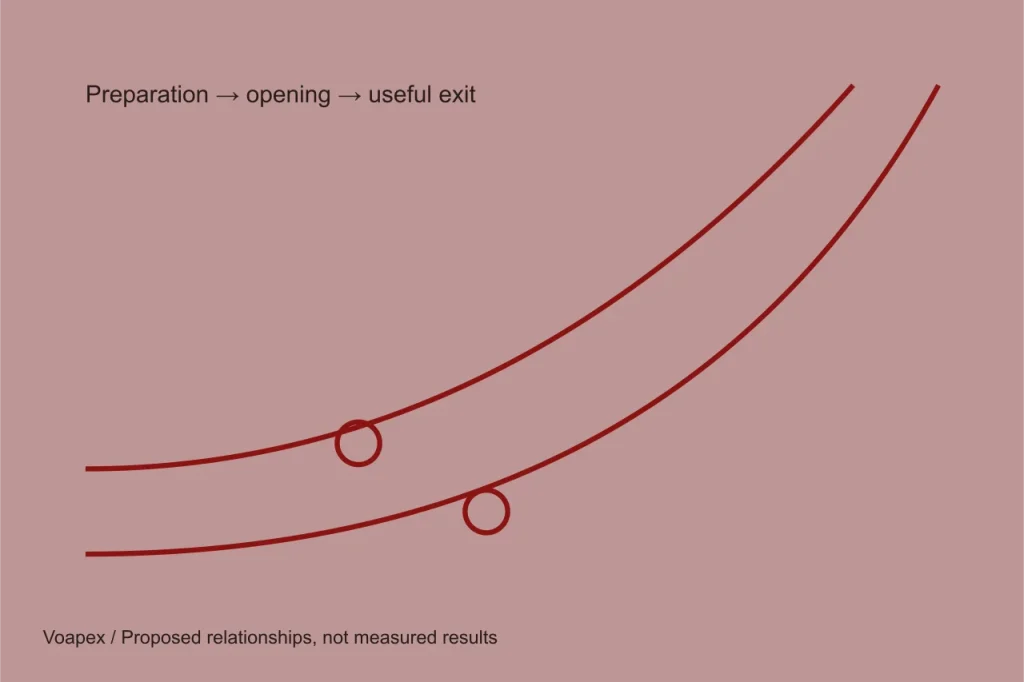
The visible gap between two craft is only one part of an overtaking opportunity. A driver may reach it too late, approach at an unhelpful angle or complete the pass with no useful exit. For Magnetic Wake, the design question begins before the gap appears. What information allows the driver to prepare a different line, and what makes that choice understandable once another racer occupies the circuit? This note proposes a way to examine that question without claiming a finished racing system.
01Read the rival as part of the geometry
A nearby craft changes the space available, but its movement also provides evidence about the next corner. Its current line can suggest which exit it is preparing. That evidence must remain readable without requiring the player to watch a tiny icon instead of the track. Clear silhouettes, restrained effects and a camera that preserves relative position are more useful than a dramatic close-up that hides the route. The rival should be an actor the driver can interpret, not a moving obstacle whose behaviour is impossible to anticipate.
02Preparation creates the useful angle
Choosing a wider approach can preserve a different exit even before a passing lane opens. The driver is investing space and perhaps immediate speed in a later opportunity. This relationship gives the corner sequence meaning. A pass that depends only on pressing an acceleration button when a prompt appears would remove much of that preparation. The concept should instead expose the connection between the earlier line and the later angle, so the driver can recognise why one attempt worked and another reached the same gap in a poor position.
03A barrier narrows more than the visible lane
Running beside the magnetic wall can reduce options for correcting an approach. It may also constrain which side of a rival is sensible to attack. The barrier-distance study treats this as a trade rather than a universal benefit. An overtaking opportunity can therefore justify leaving the wall before the gap is directly ahead. The important information is the space that will remain when the craft arrives, not only the space visible at the current instant.
04The exit belongs to the pass
Being briefly ahead does not necessarily establish a useful position for the next section. A successful pass should be assessed through the exit it creates, while avoiding an opaque judgement that contradicts what the driver sees. The circuit can communicate the cost naturally: a tight exit leaves less room for the next turn, and a wider continuation may allow the rival to respond. This produces a sequence of decisions rather than a single binary event. The interface need not turn every temporary lead into a celebratory interruption.
05Make contact rules predictable
If craft can collide, the response must be consistent enough to support judgement. An unpredictable shove can invalidate careful preparation and encourage brute force instead. The current concept does not announce a particular collision model or competitive rule set. It identifies the need to separate a legitimate narrow opportunity from a gap that cannot reasonably support two craft. Visual width, craft clearance and feedback should agree. A driver should not need to discover an invisible collision boundary through repeated penalties.
06Examine one rival and one corner pair
A useful early scenario could place a single rival on a readable route through two linked bends. The driver would have more than one approach and a clear recovery option. The question is whether an attempt can be explained through preparation and exit, rather than luck or a hidden assist. No testing results are claimed. The Handling Lab describes the broader method. A larger grid can wait until this small encounter makes the reason for a pass visible before and after the opening.